I was ten years old when I noticed that half the boys in my neighborhood were named Mahdi.
By the time I joined them, they had already known one another for years.
Most of the houses were too small to hold their large families except at night, and with no kindergartens in town, the children grew up in the alleyways, playing with rocks until they were old enough for elementary school.
As frightening as that school could be, it gave them more than an education. During school hours, it was the only place where they could gather without worrying about being run over by cars. It also gave them a chance to pool their daily allowances, buy a plastic soccer ball, and form a team that would play every afternoon after school.
At first, I called everyone Matt (Mahdi), and it worked about half the time—until I learned the real names of the other half. Then I discovered the nicknames that distinguished one Matt from another: Sari Mahdi (Blond Matt), Gara Mahdi (Black Matt), Kokha Mahdi (Fat Matt), Uzun Mahdi (Tall Matt)... and finally, the Mahdi (Matt), my classmate. He was my ticket into the gang.
Matt had a preschool-aged little brother who, by all accounts, should have been spending his days in the alley playing with rocks until someone came to take him home. Instead, he spent his time making trouble for everyone. All the other preschoolers were terrified of him. He caused problems for adults, let alone for us. Somehow, though, he never got into trouble himself.
His name wasn't Matt, of course. His older brother already had that name, so unlike all the Matts, he never needed a nickname to tell him apart from anyone else. Still, everyone called him by a nickname, Green Eyes, because of his striking eyes—greener even than mine. In a place where almost everyone had black or dark brown eyes.
One day, I watched Green Eyes throwing stones at Crazy Matt, a big guy much older than us who had the mind of a child. We all stood there, watching him being pelted with stones, doing nothing. As awful as it was, none of us minded seeing Green Eyes busy with someone else for a while. Besides, the stones he could throw weren't heavy enough to really hurt a big boy.
Then one of the stones struck Crazy Matt in the face. He dropped to the ground and covered his face with his hands.
Instead of running away, Green Eyes saw an opportunity. He bent down, picked up a much larger stone with both hands, and lifted it over his head, ready to smash it down.
Matt, who had been watching his little brother with his usual sad eyes, reacted instantly. He rushed over, snatched the stone from Green Eyes' hands, and threw it aside.
Green Eyes let out a scream as if someone had cut him. He lunged at his older brother while Matt ignored him, trying instead to help Crazy Matt to his feet.
"Get up, Crazy Matt," he shouted. "Go home!"
Green Eyes didn't let it go after Crazy Matt went home. He stood outside their house, smashing window after window, even breaking the doorbell. None of Crazy Matt's parents or siblings dared to step outside.
That broke my heart—not the broken windows, but watching an entire family hide while a little boy terrorized their home.
The next day, Green Eyes showed up happier than ever. Apparently, Matt and Crazy Matt had gotten into trouble after all and hadn't been allowed outside. This little monster was the person I hated most on earth.
Green Eyes noticed my hatred. With his older brother nowhere around to stop him, he started throwing things at me. I ignored him, and everyone else did too. Losing all that attention seemed to break his little heart. But he never gave up. He tried to steal our soccer ball to become the center of attention again. Being so small, though, he ended up darting between us like a little cat while we kept the ball away from him.
At one point, I turned around and found him standing right in front of me with his pants around his knees, and before I realized what was happening, he sprayed me in the face.
My eyes burned. I jerked backward and ran home, through the big metal gate—luckily it was unlatched. I rushed to the edge of the little garden pond and washed my face over and over, but I never felt clean.
I was furious. I was in shock, and when I came back outside, he was still there, standing proudly at the center of everyone's attention.
I grabbed his little arm and started dragging him toward his parents' house to tell them what their son had done. Banging on the tiny, rusted metal door, I hoped his father would answer.
That should have been the most terrifying moment of his life. To us, fathers were the scariest creatures alive. When I was a child, I would rather have been beaten and punished at school than have the school report me to my father. A father was the judge of the household, with absolute power. Our teachers could yell at us, punish us with a ruler or a whip, or whatever else they thought we deserved. But if they reported us to our fathers, that was another level of fear. That was the punishment we dreaded most.
An intimidating man with long beard opened the door. I immediately handed over the little monster to his dad. He pulled Green Eyes against his side, resting a hand on the boy's shoulder.
"You kid pissed on my face in public," I said.
He looked down at his son's face, and the boy broke into a broad grin from ear to ear, a silent sign of approval for what he had done. His father struggled to hide his excitement, forcing himself to maintain the same intimidating expression. Father and son fixed their gaze on me with the same unsettling delight, as though they shared a secret I was about to discover.
Then he said calmly, "I told him to. If anyone in this neighborhood upsets him, I'll lift him over my head..." He pointed his finger at the asphalt. "...and smash him into the ground."
The boy's green eyes quivered with euphoria. He rubbed himself against his father's side like a kitten seeking affection.
In the background, I saw Matt pretending he hadn't seen or heard a thing, perhaps to spare himself the embarrassment of getting involved. I pretended not to notice him either, out of embarrassment.
I turned around quickly and walked away. Maybe I cried a little. I never told my dad. The thought never even crossed my mind, remembering how he reacted when a neighbor told him that my oldest brother had tried to date his daughter.
He slapped my brother, grabbed his shotgun, pressed the barrel beneath his own chin, and shouted, "I can't live with this scandal! I'd rather kill myself than face my neighbors."
He screamed so loudly that the neighbors could hear every word. Ironically, the same neighbor who had demanded that my brother be punished, came to our door, begging my father to calm down.
We were all traumatized.
I thought I didn't need my father, or Green Eyes' father. I needed a fair judgment. Someone who wouldn't kill over a scandal, and wouldn't celebrate one either. Someone who could judge our fathers, and the fathers who had raised them. I didn’t know anyone like that. I would have asked Matt, my best friend—the one I trusted—but it was never the same between us after that. We tried to avoid each other, so we wouldn't have to talk about what had happened.
Another friend of mine told me that such a person actually existed.
"He is called a judge."
"Where is he?" I asked.
"In the new police building on Main Street. It's a two-story building. Go upstairs. There's a room up there. That's where the judge is. He gave my uncle a lot of money after a car hit him and he lost his leg. Then my uncle's wife went to the same judge and asked for a divorce. The judge gave her the money, and she left my uncle. Then someone took her money, and now she's back with the same judge."
That sounded very powerful. The very same afternoon, after the midday nap when the old shopkeepers reopened their businesses for the second half of the day, I found myself standing in front of the building. The guard stopped me.
"What do you want?"
"I have a complaint," I said.
"Go tell your dad."
"I can't. I want to tell the judge."
He paused and looked me up and down.
"Go to the petition writer," he said, pointing across the street.
On the opposite sidewalk, people were sitting on the curb. Among them sat a short man with glasses behind a tiny folding table, a typewriter resting on top. I had seen him there all my life, but had never known what he did.
"But can't I tell my complaint to the judge?"
The guard sighed, already losing his patience.
"Tell your complaint to the typist. He'll write your petition, open a file, and I'll take it to the judge in the morning."
I found the whole process too complicated and stayed quiet. Seeing the confusion on my face, he softened a little.
"Look," he said, "the judge doesn't know anything except what's written on those papers. He only signs them. If you convince the typist, you've basically convinced the court. Now go tell him your problem."
I crossed the street, weaving between the passing cars. Then I sat on the curb and waited for my turn. This new system of justice was far more intimidating than the one we had at home, where fathers were the judges. If Green Eyes' father had simply punished him for what he did, I wouldn't have had to go through all of this.
A chubby woman wearing a full hijab stood in front of the typist, shouting incessantly. She demanded that her husband be punished, insisting that both her father and her father-in-law had taken her husband's side.
"My husband yelled at me to shut up, and when I didn't, he threw the kettle against the cherry tree in the middle of the yard,” she cried out.
The typist, who had seemed thoroughly annoyed by her voice, suddenly became interested when asked whether she could pay the $200 petition fee. She slipped a hand beneath her veil and pulled out a small pouch filled with jewelry, cash, and coins, holding it up for him to see.
The typist immediately pulled a sheet of paper from the leather bag beside him with great care and precision. Within moments, his typewriter was loaded with paper and ink. Meanwhile, the woman never stopped shouting.
His fingers danced across the keys like a pianist's fingers—smooth, effortless, yet powerful. He responded to the woman's words only with an occasional nod, the way my father used to pretend he was taking notes while my mother dictated her shopping list. He already had everything he needed to craft a compelling petition.
Once he had finished typing the heading, he began murmuring the complaint aloud as he typed. The woman fell silent, listening with growing curiosity to the very words he was putting on the page.
"My husband dragged me into the middle of the yard by my hair and smashed my head against the cherry tree..."
She interrupted him.
"Are you trying to put my husband in jail, leaving me a widow and my children orphans? Are you trying to destroy my life? Do you want to help me or leave my home without a man? All I wanted was for him to be punished for not listening to me."
The typist paused. Looking at her over the rim of his glasses, he said: "Throwing things is a bad sign. It starts like that. Then one day, it's too late to do anything about it. The other day, a young woman came here with a bandage around her neck and complain that her husband had threatened to cut off her head. He apologized in front of me, and she forgave him. They went home, and the next day he finished the job."
"You're crazy. My husband isn't like that. You're here to ruin lives."
She turned and walked away, still shouting, and I immediately stepped forward and took her spot. Even after she had disappeared, I could still hear her annoying voice.
The typist suddenly grew uneasy and began muttering, "I hate wasting paper. What do you want, kid?"
"I have a complaint," I said.
"Ah, I hate wasting paper. You got any money?"
"A little," I said, showing him the twenty I had.
"Go ahead and complain," he said.
He pulled the sheet from the typewriter and held it in his hands as though it were a delicate work of art.
"Oh, I hate wasting paper," he muttered.
Then he flipped the sheet over, turned it upside down, and fed it back into the typewriter. Before I had even opened my mouth, he began typing, as if all complaints started the same.
"Go ahead," he said again, still typing the heading.
"My neighbor's kid pissed on my face," I said.
He lifted his fingers from the keyboard, raised his head, then he looked back down at the paper. He rested his hands on the keys again and paused, unable to make up his mind. It was an unusual case. He sighed again.
"Oh, I hate wasting paper. How old was the kid?"
"About five."
"Did you tell his parents?"
"Yes. His dad said, 'I told him to.'"
"Uh-huh," he replied, and he was back to typing as I gave him just enough information to finish it up, and not waste his precious paper. After a moment, he rolled the paper up a little in the typewriter and asked, "Any witnesses?"
I started counting. "Tall Matt, Fat Matt, Bald Matt..."
"Hold on, hold on." He stopped typing. "Give me their full names and last names, please."
"Mahdi Taheri," I said.
He typed it down.
"Okay. And the others?"
"I don't know their last names. Mahdi is my classmate, so I know his. He's actually the older brother of the kid who pissed on my face."
The typist lifted his hands from the keyboard again. He removed the paper from the typewriter and sighed even louder.
"Oh, I hate wasting paper." He stared at the page for a moment, his eyes half-closed as if weighing the words in front of him. Then he turned toward me. Something thoughtful crossed his face, and he said,
"Do you think you'll ever get the chance to pee on his dad someday?"
"I don't know. Maybe."
It had started to rain. He folded it. He took the twenty from my hand and handed me the paper.
"I can't give you an envelope," he said. "Keep it dry. It's good paper with good ink. If the opportunity comes, pee on his dad. And keep this with you in case you get into trouble."
Then he packed his things and left. I tucked the paper under my shirt and ran home. Once there, I trimmed the extra edges and folded it as many times as possible before shoving it into the lowest pocket of my large leather wallet, which I had gotten from my father's old belongings.. I hoped I would never, ever need it.
Days, weeks, months, and years passed. I finished school, then university, then military service. I worked here and there, including opening a successful business with my older brother in the capital, before moving on to the next chapter of my life.
That childhood drama was buried under so many others. I even went through real court experiences, with lawyers and prosecutors involved. The only times I remembered that trauma were when I saw eyes greener than my own, something incredibly rare in that part of the world.
I saw a pair once, at an old gas station near my hometown, when I was thirty years old. I was driving back to my hometown after many years, knowing I would soon leave again for many more, just before immigrating to Canada.
My head was in the clouds. I was about to begin what would probably be the biggest chapter of my life. I already had my expensive ticket booked.
That day, after driving hundreds of miles nonstop, I pulled over to fill up my nearly empty tank and empty my nearly full bladder before driving into my hometown.
I saw a homeless man walking into the gas station. He was in terrible shape, perhaps the result of a severe drug addiction. All his hair was gone, exposing the thick veins beneath the skin stretched over his gaunt skull. His unnaturally green eyes, standing out from his sunken face, caught my attention. They reminded me of Green Eyes.
Although he was older than me, that didn't stop me from indulging the fantasy that he was Green Eyes and that God had finally punished him for what he'd done to me.
Looking back on that memory with my adult mind, I realized that the trauma hadn't been caused by Green Eyes' actions. It had been caused by his father's reaction. That was the real shock, especially because it was the complete opposite of how I believed my own father would have reacted.
The memory stirred up old resentment, but it was softened by the sight of the kind old attendant calmly helping the car in front of me fill up. Most gas stations had no fuel because of the ongoing political turmoil, so his quiet courtesy was unexpectedly comforting.
However, the kind gas station attendant returned to his office before I pulled up to the pump. To my surprise, the very same pump had suddenly run out of fuel. I probably could have made it to the next gas station, but there was no chance my bladder would have made it that far.
I locked the car and rushed to the washrooms. The rusty door wouldn't budge. Maybe it was jammed. Maybe it was locked. My bladder was under so much pressure that I could barely think straight, and the moment the smell of the toilets reached me, it became even harder to hold it. Better ask the kind old attendant, I thought, and rushed to his tiny office.
"We don't have washrooms," he said without even lifting his head.
His answer caught me completely off guard. Now, alongside the mounting pressure in my bladder, I felt anger rising too.
I heard a door open, and someone stepped out of a tiny corridor in the corner of the office. I turned my head and saw the same homeless man emerging from the employees' washroom. He never looked at either of us. Instead, he lowered his bony frame onto the metal chair beside the tea maker next to the desk and calmly began preparing his pipe.
We were all crammed into the tiny office, no more than ten square feet, and he was getting ready to smoke right there.
My emergency was my only concern at that moment. I said, "I'll use the employee washroom if you don't mind," and turned to go.
"We don't have a washroom," he repeated.
"What is your problem, man? Everyone else can do whatever they want here except me? He just walked out of that washroom and is now sitting here preparing his pipe inside the gas station."
"I told him to," he replied, finally looking me in the face.
His words struck me like a judge's gavel. Then they began echoing in my head like the toll of a church bell.
I told him to... I told him to...
A smile of satisfaction lit up his face as he turned his eyes toward the homeless man.
My gaze shifted back and forth between the two of them while the words kept echoing in my head.
I told him to... I told him to...
The homeless man remained completely absorbed in what he was doing, as though nothing else in the world existed. Still, he slowly turned his head toward the old man, blinked lazily in acknowledgment, and went back to preparing his pipe.
No way, I thought. They were the same father and son, performing the same play they had performed decades earlier. It was him.
Green Eyes.
He only looked older because of years of severe addiction. I couldn't say a word. I simply turned around and walked away. I had always imagined I would react differently once I was grown up. I sat in my car, my bladder on the verge of giving up.
"Go ahead. Pee on your car seat. Maybe you'll cry a little too," I said to myself out loud.
"Not this time."
I got out of the car and rushed back to the office without any plan, and walked straight toward the employees' washroom without asking permission. The old man followed me with a puzzled look.
The door was locked.
"Oh, damn it! Open this door! Open it, or I'll pee in your office!"
"And I'll put you in jail," the old man shouted back. "I'll hand you over to some people I know".
He was probably referring to the fellow who looked just like him—the long-bearded man who had his tank filled before me and was treated with the kind of cheerful, customer-service smile I hadn't received.
It was too late to argue. I was about to pee my pants. I had barely managed to pull down my zipper before it started. I pressed myself into the corner, trying to stay out of the old man's sight behind his desk. Green Eyes was only a few feet away, yet he seemed utterly uninterested in what was happening.
As the pressure finally left my body, a strange tingling spread across my face. I heard the old man scrambling to get out from behind his desk. He turned toward the corridor, caught sight of the wet floor, and instinctively tried to pull back. His shoes lost their grip. A split second later, he was lying at my feet.
The fall startled me. I turned instinctively and found him taking an unwanted golden shower between my legs. I couldn't stop peeing, even if I'd wanted to.
The old man tried to get back on his feet, pushing himself up with his hands braced against his knees, but he slipped again and threw up. This time, he only managed to lift his face off the wet floor with both hands. Drained of energy, he stayed there coughing and vomiting until I had completely emptied my bladder and zipped up my pants. I had to step over him to make my way through the filthy, cramped corridor.
Green Eyes and I watched as the old man dragged himself into the washroom and continued vomiting behind the rusty door.
Green Eyes, who seemed more awake after taking his dose, finally opened his mouth.
"You're in trouble."
"But you never got into trouble for pissing on my face."
He looked at me without recognition.
"I don't know what you mean. But this isn't about me. His hobby is collecting evidence on people and taking them to court.”
He nodded toward the surveillance camera above his head. It was pointed straight at the corridor.
Seeing the camera, his words sank in. Suddenly, it all made sense. That was why no one in the neighborhood dared confront him, not even when his little boy went around smashing their windows.
I was in trouble. That's when I remembered the paper the typist had given me—the one that was supposed to save me if I ever got into trouble with my dad, for peeing on Green Eyes' father. But it couldn't save me now. Not from a real court. Maybe it could have saved me from my father's punishment when I was a child, but not anymore. Twenty years had passed, and I had never looked at that paper again. If it was still anywhere, it had to be buried deep inside my wallet.
I reached into my back pocket and pulled out my tiny leather wallet, the very same one that had felt so much bigger twenty years earlier. I forced two fingers into the bottom pocket, now so tight that I could barely reach the bottom. My fingertips touched something buried deep inside. I pinched it between my fingers and slowly pulled it out. It was the paper. The very paper the typist had given me twenty years earlier, telling me, "Hold on to this in case you get into trouble."
I let out a despairing chuckle and handed the folded paper to Green Eyes.
He unfolded it with the same care he had used to unfold his packet of poison earlier. He managed to open it without tearing it apart. The ink had long since faded, but the letters, deeply embossed into the paper by the typewriter, were still legible.
"It's an old complaint," he said.
"More than twenty years old," I replied. Then, imitating the typist's voice, I added, "But it’s good paper."
Green Eyes began reading it aloud, loud enough for me to hear, but his voice blending with the old man's coughing from behind the rusty washroom door.
"In the year 1993... In Naghadeh, Iran... Mohammad Taheri pissed on my face... His father, Ali Taheri, responded, 'I told him to.'... Witness: Mahdi Taheri..."
Green Eyes' voice trembled as he read his older brother's name.
"Matt is dead," he continued. "I never told anyone. No one would believe an addict anyway. About ten years ago, one day my mother was screaming when she found out I was dealing drugs. As usual, my father took my side. He started beating her instead. Matt couldn't take it anymore. He stepped in to defend her. My father threw him out of the house that very day. We all thought he'd come back that night. He never did."
My mother, having lost the only person who had ever given her hope, fell into a deep depression. She waited for him until the day she died.
Years later, a friend of mine who eventually died of an overdose told me that Matt had joined the army and died like a hero.
I never told my mother. She died without ever knowing what had happened to him. Matt never agreed with my father's way of doing things.
My father loved me more because I had always been useful to him. Every little trouble I got into gave him another chance to call his friends in the government, fix the problem, and make himself feel powerful—like a hero rescuing his dear son. And here we are. Thanks to my father, I can take drug myself to death and no one can touch me. Now you're his next project. He'll make sure you go to jail and stay there for a good while."
Tapping his brother's name on the old paper, he continued:
"If Matt were here, he would've been a good, honest witness. He would've stood on the side of what was right, not on his father’s."
Then his head dropped, and he began sobbing. Tears ran freely down his face, accompanied only by the old man's fading coughs behind the washroom door. He lifted the paper to his face, pressing his brother's typed name against his wet eyes.
"I miss you so much, brother," he cried.
How selfish was I to be thinking about my visa to Canada while he stood there crying over the brother he had lost? How could I explain, at that moment, to a man who had never even left his hometown—not even for a road trip—that even a false complaint against me could cost me my flight, and perhaps my only chance to make it to Canada?
By then, the old paper had turned to pulp. It slipped from between his fingers, dissolved into the urine spreading across the floor, and slowly drifted toward the step at the entrance to the office.
Matt was gone. The paper was gone. The typewriter was gone. And, most likely, so was my visa to Canada. I turned around without saying a word and walked out of the office. I should go say goodbye to my family, I thought. Not goodbye to Canada. Goodbye to prison. Or maybe I should stay at the crime scene and wait for the police to arrive.
As I stepped off the curb, I turned around for one last look at the mess I had left behind. Green Eyes was standing at the edge of the office, his arm stretched toward me. A VHS tape rested in his hand.
"Here are the surveillance recordings," he said calmly. "Matt would've done the same."
I took the tape from him. My throat tightened.
"Matt would've done the same."
It felt as though he had just handed me back my freedom, my future, and my visa to Canada.
The stream of urine reached the edge of the curb and dripped down. But every drop felt heavy, hitting the ground like a judge's gavel after the verdict had been delivered.
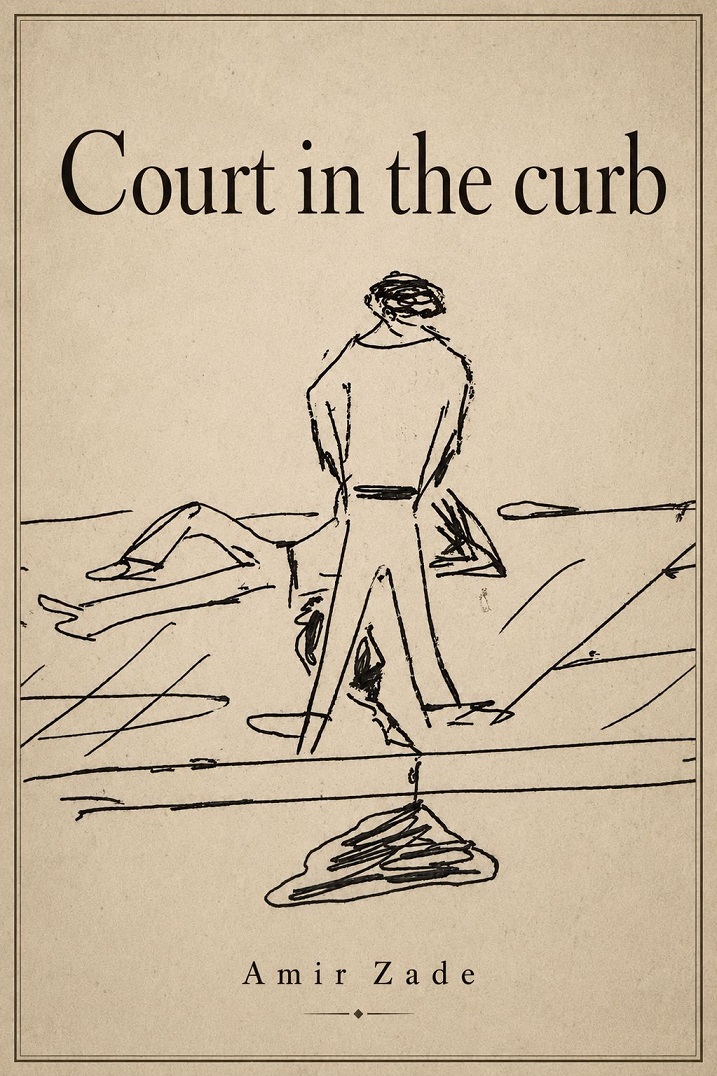
In my imagination, that curb became a courtroom. The typewriter occupied the judge's bench. Mahdi sat in the witness stand. I stood as the plaintiff, and at last, the old man was being tried fairly. Green Eyes was only a spectator, sitting hand in hand with his mother.